

How to Train for Annapurna Base Camp
Build an easy engine, then stairs and descents, then linked long days. An 8 to 10 week order with a sample week, and how it grows for the Circuit.
 By Nathan Gee, BSc Sports Science · Updated 14 October 2026 · 9 min read
It is a Saturday and you are on the stairs of the same car park for the sixth time. Nobody has ever put this on a postcard. Somewhere in Nepal there is a stone staircase you will never see in a photograph, and it is waiting for exactly this.
Spend the first weeks on easy walking volume, then add stair and hill work and controlled descents, then practise back-to-back long days with your pack, and ease off in the last week. Keep most work easy enough to talk through.
- Train stairs, descents, long days and eating, in that order of priority.
- Two short strength sessions a week protect your knees on the way down.
- Taper in the last week and start the trek slowly.
What Annapurna actually tests
Train the demands, not a generic fitness number.
The trail asks for four things above all: climbing stairs for hours, controlling long descents, repeating a long day several times and eating well while you do it. Everything in this plan serves one of those.

The three pillars of training
Everything else is a detail.
- An easy aerobic engine
Most weekly volume should feel easy enough to talk through. It lets you walk for hours and recover for tomorrow.
- Strength for stairs and descents
Two short sessions a week build the single-leg control stone steps ask for and protect your knees on the way down.
- Time on your feet with a pack
A weekly long walk with the load you will carry, rehearsing food, water and layers.
How the weeks fit together
Choose the structure that matches your trek.
Base Camp: 8 to 10 weeks
| Phase | Weeks | Focus |
|---|---|---|
| Base | 1 to 3 | Easy walking volume, one longer walk, two short strength sessions |
| Make it specific | 4 to 6 | Stairs and hills, step-downs, longer hikes with the daypack |
| Repeat days | 7 to 9 | Two hilly walks on consecutive days, rehearse food, water and layers |
| Taper | Final week | Reduce load, keep moving easily and avoid a last-minute test |
Circuit: 12 to 14 weeks
| Phase | Weeks | Focus |
|---|---|---|
| Base | 1 to 4 | Easy walking volume, a longer weekly walk and a strength habit |
| Make it specific | 5 to 8 | Stairs, hills, step-downs and loaded hikes building in length |
| Repeat days | 9 to 12 | Back-to-back long days and a three-day block with the pack |
| Taper | Final week | Reduce load by about half and arrive fresh |
A build-phase week
Use it as a template and swap days to suit.
| Day | Session | Why |
|---|---|---|
| Mon | Rest or easy walk | Recover from the weekend |
| Tue | Strength, 30 to 40 minutes | Step-ups, squats, calf raises, core |
| Wed | Stairs or hills, 45 to 60 minutes | Uphill capacity for the steps |
| Thu | Strength, 30 minutes | Single-leg work and step-downs |
| Fri | Rest | Prepare for the weekend |
| Sat | Long hilly walk, 3 to 5 hours | Time on feet, food and pacing |
| Sun | Shorter walk, 1 to 2 hours | Repeat-day tolerance |
Train the trail, section by section
Match your training to what the route asks.
Villages and stone steps
Stair sessions, step-ups with a daypack and one weekly hill walk that climbs for 45 to 60 minutes without a break.
The river drop and climb
Slow step-downs, then gradual descents, then a short climb straight after. Rehearse the pattern, not just each half.
The forest climb
A long, steady walk at an effort you can talk through, in layers you can adjust.
The upper valley
Practise eating and drinking on a schedule, and keep the pace boring on purpose.
The return
A long walk that ends with a long descent, with the pack and poles you will use.
 River valley · forest and white water
 Above the trees · the valley opens up
 Upper valley · snow on the trail
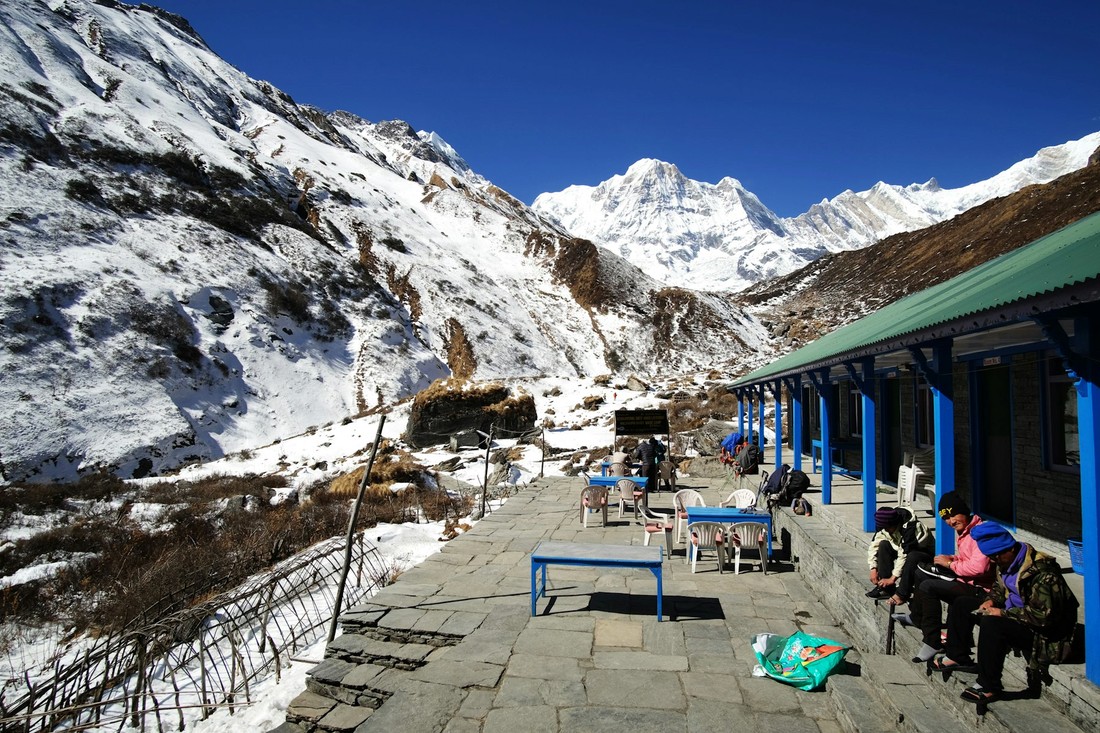 Teahouse terrace · rest with a view
 Machhapuchhre · first light on the fishtail
How to train for the downs
The part most people leave out.
- Step-downs
Slowly lower from a step, tap the heel, return. Two to three sets of eight to twelve per leg.
- Gradual descents
Find a long, gentle descent and walk it with control. Start at 20 minutes and build.
- Add the pack
Once comfortable, repeat with your daypack and poles.
Descents cause soreness for days, so introduce them early and do not stack them in the final week.
Rehearse the details
Small things become big on day five.
- Eat on a schedule
Appetite fades with effort and height. Practise eating when you do not feel like it.
- Wear the real kit
Boots, pack and layers. Blisters and rubbing show up on long days, not short ones.
- Taper and travel
Cut volume by about half in the final week and start the trek slowly. Fast starters pay later.
Five mistakes that cost people the trek
All of them are avoidable.
- Training only the climb
The steps down leave people limping on the last two days.
- Doing too much, too late
The final fortnight is for freshening up, not catching up.
- Never wearing the real kit
New boots on day one is a common and avoidable problem.
- Skipping the long day
The weekly long walk rehearses everything together.
- Ignoring sleep and food
Under-recovered training feels like a fitness problem and is not.
Training will not make you immune to altitude illness. Agree turn-around rules with your guide before you set off.
The two strength sessions
Short, repeatable and aimed at stairs and descents.
| Session | Moves | Notes |
|---|---|---|
| A: legs and control | Step-ups, split squats, slow step-downs, calf raises | Three sets of eight to twelve, slow on the way down |
| B: single-leg and trunk | Single-leg Romanian deadlift, side planks, glute bridges, carry | Keep a rep or two in reserve |
Do them on separate days with a gap between them and the long walk. Progress by adding a set or a little load, not both at once.
Rehearse a mountain day
One long walk a week is where everything comes together.
- Eat on a schedule
Appetite fades with effort and height. Practise eating when you do not feel like it.
- Use the real pack and boots
Wear what you will carry and walk in. Blisters and rubbing show up on long days, not short ones.
- Finish with a descent
Plan the route so the last part is downhill. That is how the trek ends, so train it.
The last fortnight, and the way in
The work is done. Protect it.
Cut volume by about half in the final week, keep a few easy walks to stay loose and avoid anything new. Once you arrive, start the trek slowly: the first days are where fast starters pay later. Sleep and food matter more than another hard session.
Altitude illness depends on how you ascend and how you respond to symptoms, not on how fit you are. Agree turn-around rules with your guide before you set off.
If you are training for the Circuit
Longer, higher, and more repeat days.
The plan grows by four to six weeks. Build to a three-day block of long walks with a loaded pack, keep strength and descent work going throughout and add an acclimatisation plan to the itinerary. The Thorong La day is long and cold, so rehearse early starts and keeping warm and fed while you move.
Annapurna: FAQ
How do I train for Annapurna Base Camp?
Build easy aerobic volume, add stairs and hill work, practise slow step-downs and controlled descents, then link two long hilly days with the pack you will carry. Taper in the last week.
How many weeks do I need?
Eight to ten weeks if you already walk regularly, and longer from low activity. Twelve to fourteen for the Circuit.
What is the best exercise for the steps?
Stair climbing and step-ups with a daypack. Build the volume gradually so your knees keep up.
How do I train for the descents?
Slow step-downs, then gradual downhill walking, then the same with a pack. Introduce them early so soreness settles before the trek.
Do I need a coach?
No, a good plan is enough for most people. 1:1 coaching helps if you want feedback, have an injury history or limited time.
Trek Ready is an eight-week self-guided programme that builds exactly this. 1:1 coaching adds feedback, and a personalised plan fits it around your dates.
- Annapurna Base Camp trek guideRoute map, day cards, versions and the seven demands.
- Nepal trekking hubEvery Himalayan trek Peaksted covers, with a route finder.
- Trek Ready, 8 weeksA structured plan that builds exactly these capacities.
- Eating and drinking at high altitudeHow to keep fuelling when appetite fades.
- How hard is Everest Base Camp?The classic Khumbu trek, rated the same way.
- How hard is Everest Three Passes?Three high crossings and the longest Khumbu circuit.
- Strength training for hikersThe two short sessions that protect your knees on descents.
- Stair training for trekkingThe most specific preparation for stone steps.
Sources and scope
Route and season information follows the Nepal Tourism Board page on the Annapurna Conservation Area and the Nepal tourism itinerary. Heights and stage times are approximate and vary with road access, weather and your itinerary. Confirm current permit, TIMS and guide requirements with an official source and a registered local operator. Altitude illness can affect anyone, whatever their fitness: tell your guide about symptoms and descend if they worsen. Training guidance is general and based on the demands described, not a personal prescription. Written by Nathan Gee, BSc Sports Science. If you have a health condition or injury, speak to a doctor or physiotherapist first.

