Times, conditions and route variants can change. Check current local guidance before you set your itinerary.
OVERVIEW
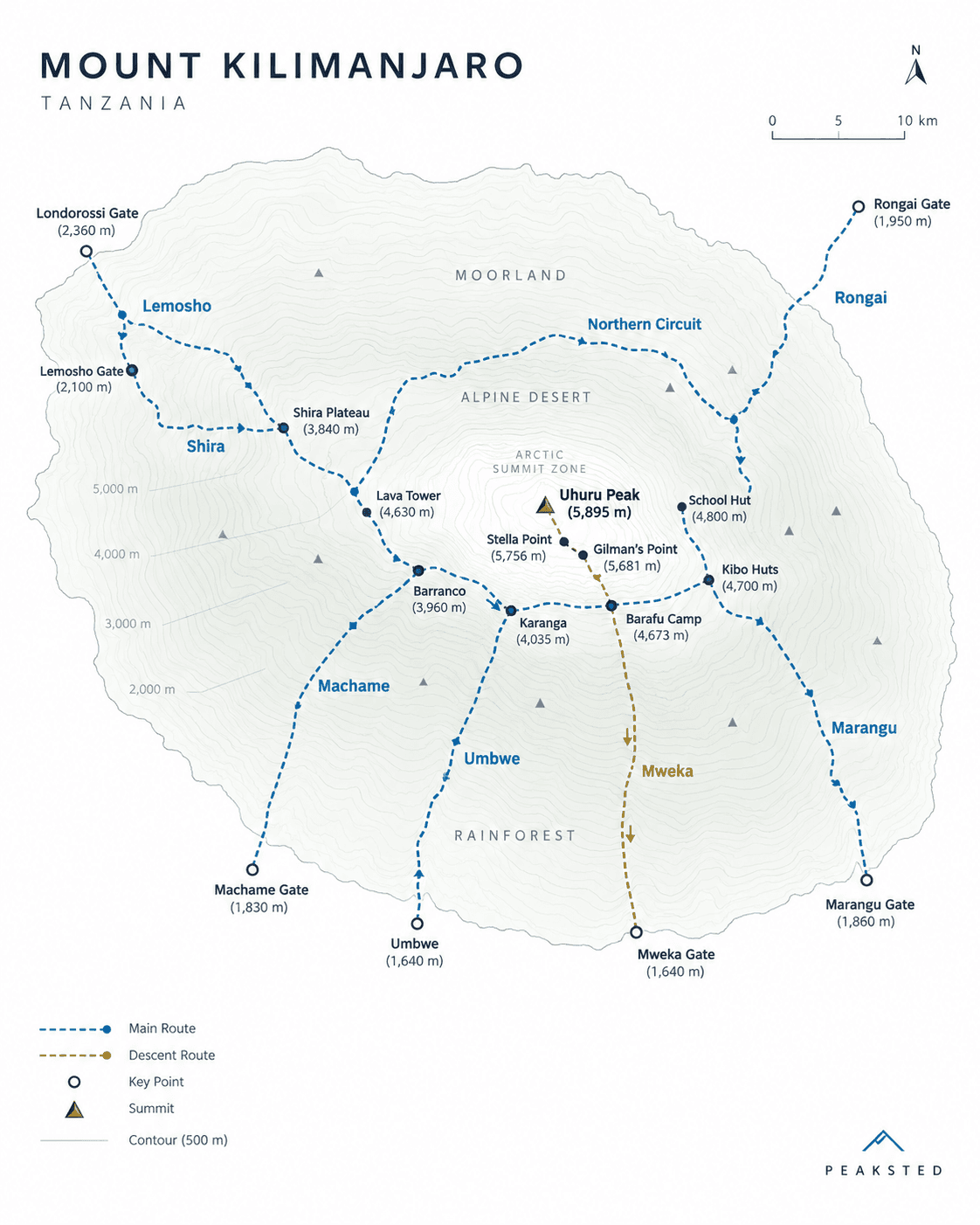
Kilimanjaro is a high-altitude, non-technical trek to 5,895 m — the highest point in Africa. Most itineraries take around 5–9 days, climbing through rainforest, moorland and alpine desert before the final summit push to Uhuru Peak. The challenge is not technical climbing; it is the combination of sustained uphill work, repeated days on your feet, cold conditions and rapidly increasing altitude. Route choice matters because it changes the pace of ascent, acclimatisation opportunity, terrain and overall experience.
Kilimanjaro is a high-altitude, non-technical trek to 5,895 m — the highest point in Africa. Most itineraries take around 5–9 days, climbing through rainforest, moorland and alpine desert before the final summit push to Uhuru Peak. The challenge is not technical climbing; it is the combination of sustained uphill work, repeated days on your feet, cold conditions and rapidly increasing altitude. Route choice matters because it changes the pace of ascent, acclimatisation opportunity, terrain and overall experience.
Kilimanjaro is a high-altitude, non-technical trek to 5,895 m — the highest point in Africa. Most itineraries take around 5–9 days, climbing through rainforest, moorland and alpine desert before the final summit push to Uhuru Peak. The challenge is not technical climbing; it is the combination of sustained uphill work, repeated days on your feet, cold conditions and rapidly increasing altitude. Route choice matters because it changes the pace of ascent, acclimatisation opportunity, terrain and overall experience.
Tanzania · Kilimanjaro
Free readiness check
How ready are you for Kilimanjaro?
Twelve questions, about three minutes. See your score against what Kilimanjaro asks of you, and the one gap worth fixing first.
There is no single Kilimanjaro route. Each approach differs in duration, terrain, crowd levels, accommodation and — most importantly — how gradually you gain altitude. The shortest route is not automatically the best choice; more time on the mountain generally gives your body more opportunity to adapt.
Selected route
Machame
A popular southern route with varied terrain and useful changes in altitude before the summit phase. It offers a strong balance between scenery, duration and acclimatisation opportunity, although it is one of the busier routes.
Typical Duration
6–7 days
Approach
South / southwest
Accommodation
Camping
Profile
Varied + progressive
Route durations vary between operators and itineraries. Route choice should consider acclimatisation opportunity as well as scenery, cost and schedule.
From rainforest to a glacier-capped summit
Kibo, the volcano you are climbing
Lower slopes · the warm approach
Montane forest · humid trail
Day by day, pole pole
Heath and moorland · open ground
Alpine desert · rock and temperature swings
Camp on the mountain
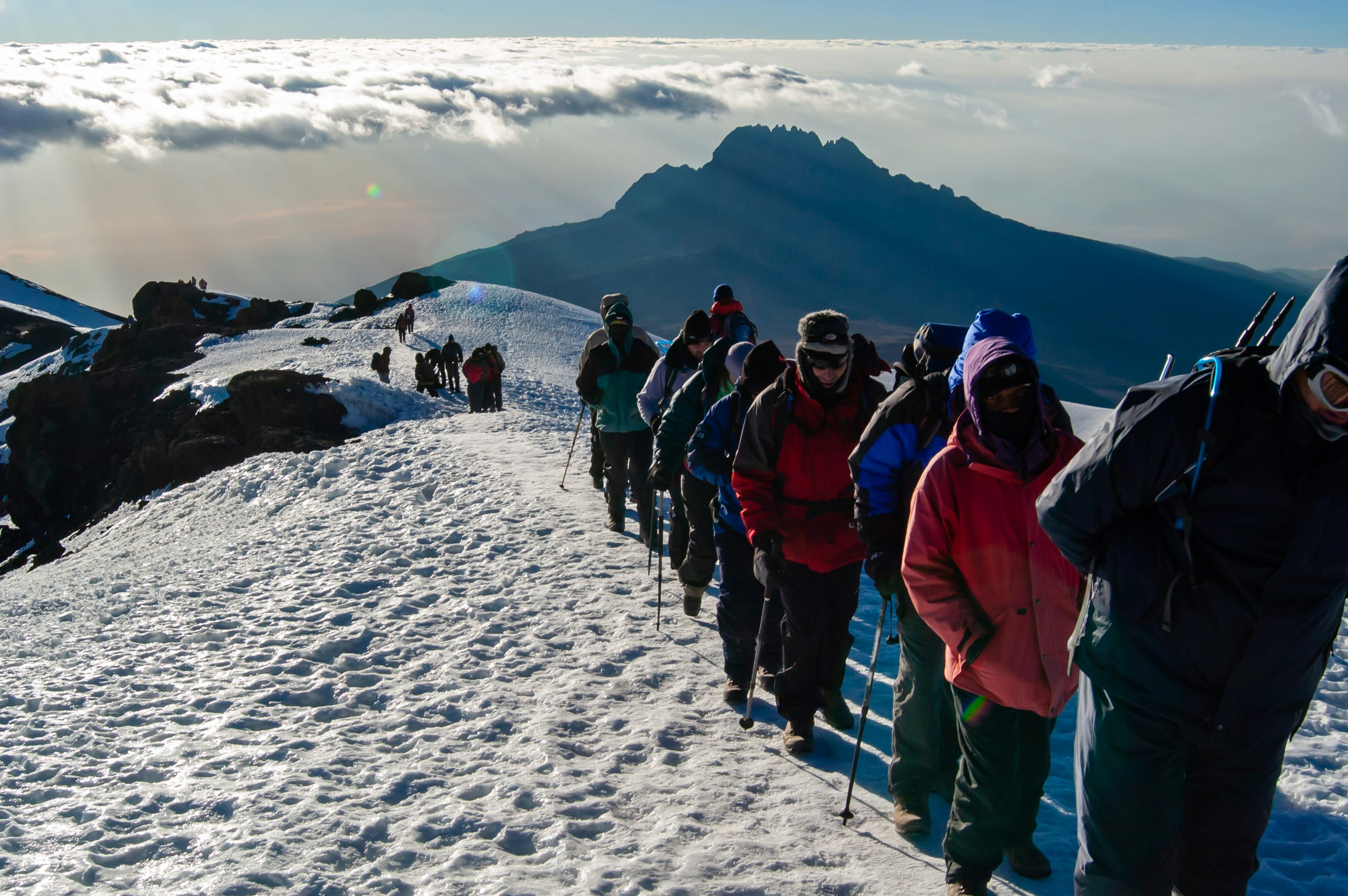
Summit zone · cold, scree and thin air
1 / 8
What matters most
Height5,895 m
Uhuru Peak, the highest point in Africa.
Length5–9+ days
Longer itineraries give your body more time to adapt.
Summit night6–8 hours up
A midnight start, then about 2,800 m of descent the same day.
Train forSlow and repeatable
Easy aerobic hiking, two long days in a row and slow, controlled descents.
Time to prepareAbout 12 weeks
On top of an existing routine. Eight weeks is the minimum for a structured plan.
Fitness and altitudeNo immunity
Fitness helps the walking. A gradual ascent and honest reporting protect you.
Three quick taps show where to start. It is not your full score.
03 / YOUR PLAN
Which Peaksted plan fits your Kilimanjaro preparation?
Kilimanjaro rewards a slow, repeatable engine, leg control on a long descent and the patience to hold pace. Pick the support that fits your timeline.
Answer both questions to see the plan that fits your Kilimanjaro preparation.
04 / PROOF
Who is coaching you, and what clients say
Nathan GeeBSc Sports Science · 8 years coaching strength and conditioning · mountain guide
Lauren JonesStudying towards NASM Sports Nutrition Qualification · co-founder and content lead
★★★★★
“Before Trek Ready I was doing plenty of cardio, but my training had no real structure. The programme gave me a clear plan and I felt noticeably stronger and more capable on longer hikes.”
“Having the training built around my actual trek made a massive difference. I knew exactly what I was training for each week instead of just trying to get generally fitter.”
It is non-technical, but altitude, cold and summit night make it demanding. The summit is 5,895 m and most itineraries take 5 to 9 days. It is the stacking of days, then a long night in thin air, that is the test.
How fit do I need to be for Kilimanjaro?+
Well prepared, not elite: able to walk for hours with a pack, on consecutive days, at a pace you can hold. The fitness guide shows your starting point and how many weeks you need.
How long should I train for Kilimanjaro?+
About 12 weeks on top of an existing routine is a good target. With less, a shorter plan still helps, and Trek Ready is built around 8 weeks.
Can fitness stop altitude sickness on Kilimanjaro?+
No. Fitness helps the walking, but how quickly you ascend and how you adapt matters most. Choose a longer itinerary, walk slowly and tell your guide early.
What is pole pole and why does it matter?+
Pole pole means slowly, slowly. It is the pace you can sustain for hours even when you feel good, and it is the most useful skill you can practise.
What should I train most for Kilimanjaro?+
Easy aerobic hiking with a pack, two long days in a row, slow controlled descents and strength twice a week.
Do I need to train at altitude?+
Most people cannot and do not need to. Focus on fitness, pacing and a longer itinerary, and do not use altitude simulation without medical advice.
How cold does it get on summit night?+
Very cold, and being cold drains energy fast. Test a layering system, warm hat and gloves and a sleeping bag rated for the cold before you go.
Peaksted does not book treks. Your operator arranges the guide team, park fees and camps, so confirm current rules with them and Tanzania National Parks. What we cover is arriving prepared. TANAPA Kilimanjaro visitor guide.
Written by Nathan Gee · Reviewed 6 Oct 2026 · General education, not medical advice. If you have a health condition, talk to a doctor before you train or book.



 Start here


