
STRENGTH FOR THE MOUNTAINS / GYM
Strength Training
for Hiking
Full-body gym workouts that serve the mountain.
Those last steep steps before a hut—and the descent on tired legs—are what this gym work is for. Start with movements you can control, train twice a week if recovery allows, and keep your long walks in the plan.
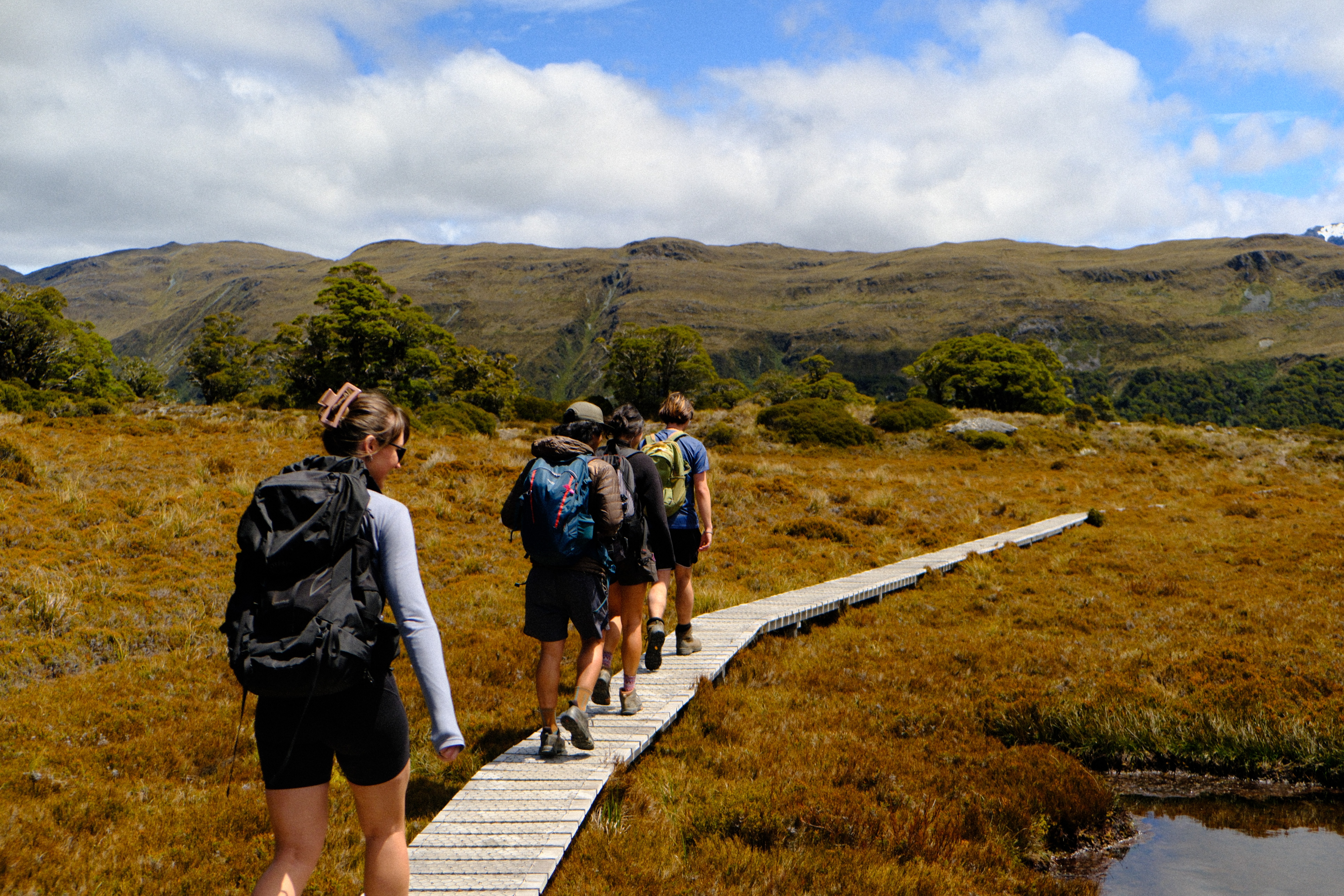
01 / WHY STRENGTH MATTERS
Train for the work the trail asks of you.
Hiking strength is more than a bigger squat. A useful gym plan supports repeated climbs, controlled descents, pack carrying and stable movement when you are tired. It complements walking, terrain practice and recovery.
02 / EXERCISE LIBRARY
Nine useful strength exercises for hiking
Find the movement you need. Each exercise has a practical starting dose, a technique cue and a way to make it easier or harder. The two workouts below put them into a complete plan.
Build climbing and descending strength
Squat, step and hinge patterns develop force and controlled lowering for long days on uneven ground.
01Goblet squatBuild leg strength for repeated climbing2 × 6–10
How: Keep your whole foot grounded; stand up smoothly.
Start here: 2 × 6–10. Choose a load that leaves about two or three clean repetitions in reserve.
Make it easier: Bodyweight squat to a bench.
Progress it: Add a small amount of weight after you own the full rep range.
02Step-upPractise the shape of an uphill step2 × 6–8 per leg
How: Use a low, stable step. Let the leading leg do the work, then lower with control.
Start here: 2 × 6–8 per leg. Choose a load that leaves about two or three clean repetitions in reserve.
Make it easier: Use a lower step and light hand support.
Progress it: Add light dumbbells or a slightly higher step, one change at a time.
03Split squatStrengthen each leg and control the descent2 × 6–8 per leg
How: Use a comfortable stance and lower slowly without collapsing inward.
Start here: 2 × 6–8 per leg. Choose a load that leaves about two or three clean repetitions in reserve.
Make it easier: Shorten the range and hold a rail.
Progress it: Add dumbbells when both sides move equally well.
04Romanian deadliftTrain hips and hamstrings for long days2 × 6–10
How: Move your hips back, keep the weight close and stand tall.
Start here: 2 × 6–10. Choose a load that leaves about two or three clean repetitions in reserve.
Make it easier: Practise the hinge unloaded or with light dumbbells.
Progress it: Increase load while maintaining the same back position.
05Calf raiseBuild lower-leg capacity2 × 8–12
How: Move through a comfortable range and lower without bouncing.
Start here: 2 × 8–12. Choose a load that leaves about two or three clean repetitions in reserve.
Make it easier: Use both legs and a rail for balance.
Progress it: Try a single-leg variation or modest added load.
Support posture and pack handling
Pull and push work rounds out a full-body plan without taking over the week.
06Row or pulldownSupport posture and pack handling2 × 8–12
How: Keep shoulders relaxed and return the weight slowly.
Start here: 2 × 8–12. Choose a load that leaves about two or three clean repetitions in reserve.
Make it easier: Use a light band or cable.
Progress it: Add weight only while you can keep the same control.
07Upper-body pressBalance pulling work with pushing strength2 × 8–10
How: Keep your ribs stacked and use a comfortable shoulder range.
Start here: 2 × 8–10. Choose a load that leaves about two or three clean repetitions in reserve.
Make it easier: Incline push-up against a sturdy bench.
Progress it: Lower the incline or use dumbbells.
Move steadily under load
Carries and anti-rotation work help you hold your shape as terrain and fatigue change.
08Loaded carryPractise moving well under load2 × 20–40 seconds
How: Walk naturally, breathe and keep shoulders level.
Start here: 2 × 20–40 seconds. Use a manageable load that lets you walk naturally and breathe steadily.
Make it easier: Carry lighter dumbbells for a shorter distance.
Progress it: Add a little time or load, not both at once.
09Pallof pressKeep your trunk steady on uneven ground2 × 8–10 per side
How: Press away from your chest without turning your torso.
Start here: 2 × 8–10 per side. Choose a load that leaves about two or three clean repetitions in reserve.
Make it easier: Use a lighter band or stand closer to the anchor.
Progress it: Pause with arms extended or increase band tension.
03 / PEAKSTED STRENGTH SESSIONS
Two full-body gym workouts for hiking.
Do A and B on nonconsecutive days alongside your walking. Allow about 35–50 minutes, including a 5–8 minute easy warm-up. Choose loads that leave roughly two or three clean repetitions in reserve.
Example week: Tuesday A · Friday B · Weekend long walk. Move the days to protect your hardest hike.
A / Climb & carry
Leg drive, climbing mechanics and carrying
- Goblet squat2 × 6–10Rest 90 sec
- Step-up2 × 6–8 / legRest 60–90 sec
- Cable row2 × 8–12Rest 60 sec
- Calf raise2 × 8–12Rest 45–60 sec
- Farmer carry2 × 20–40 secRest 60 sec
B / Descend & stabilise
Hips, single-leg control and trunk stability
- Romanian deadlift2 × 6–10Rest 90 sec
- Split squat2 × 6–8 / legRest 60–90 sec
- Upper-body press2 × 8–10Rest 60 sec
- Pulldown or row2 × 8–12Rest 60 sec
- Pallof press2 × 8–10 / sideRest 45–60 sec
New to lifting? Start with one set of each movement, then build toward two. If soreness disrupts your long walk, lower the load or volume rather than forcing the next session.
PEAKSTED / TREK READY
Turn the pieces into a plan.
These workouts show what a useful strength session can look like. Trek Ready combines strength with aerobic work, uphill and downhill preparation, pack practice and Mountain Days in an eight-week programme.
- Base and Summit options: four or five sessions each week
- Home and gym training options
- Exercises, progression and tracking delivered through FITR
04 / PROGRESS WITHOUT LOSING THE WALK
Build gradually. Keep the trail in view.
Choose a repeatable load
Start at the lower end of the rep range. Finish each set with smooth form and room for another two or three reps.
Earn the next increase
When you reach the top of the range in two sessions with good control and recovery, add a small amount of load.
Protect your long walk
Keep the harder leg session away from your longest hike. Back off if soreness, sleep or joint symptoms tell you the work is too much.
Strength work does not replace time on your feet, descents, uneven ground, pack practice or altitude acclimatisation. Pair this plan with route-relevant walking and progress according to your recovery. Train for a multi-day trek without mountains →
05 / COMMON QUESTIONS
Before you begin
How often should I strength train for hiking?
For many trekkers, two full-body sessions on nonconsecutive days are a manageable starting point. Your current training, walking volume and recovery should shape the final schedule.
Can I prepare with gym work alone?
No. The gym builds useful capacity, but you still need progressively longer walks and, where possible, hills, descents and pack practice that resemble your trek.
Should I lift heavy or do very high repetitions?
Use a load that lets you move well through a moderate rep range. Progress when your technique and recovery are reliable. There is no single set and rep scheme that guarantees hiking readiness.
Is strength or cardio more important for hiking?
They solve different problems. Walking and easy aerobic work build the capacity to keep going; strength helps with steep steps, descents and carrying. A trek plan needs both in amounts you can recover from.

