

Annapurna Base Camp Altitude Explained
At about 4,130 m the finish is lower than Everest Base Camp, but altitude still counts. What changes, how the route climbs and what to respect.
 By Nathan Gee, BSc Sports Science · Updated 14 October 2026 · 8 min read
Day five. Nothing is wrong. The pack is light, the path is clear and the sun is out, and you are breathing like you have just taken the stairs at home. That is altitude: not a drama, a quiet tax on every step, and the reason the quiet, unhurried people are the ones who arrive well.
The air has the same oxygen percentage but lower pressure, so every breath delivers less. Fitness helps you move but does not make you adapt faster. Go slowly, sleep lower when you can, know the early signs and agree turn-around rules with your guide.
- Same oxygen percentage, lower pressure: each breath delivers less.
- Fitness does not make you adapt faster. Pace and sleeping height do.
- Know the early signs, and agree turn-around rules before you go.
Same air. Lower pressure. Harder work.
The percentage of oxygen does not change. The pressure pushing it into your blood does.
The air at Annapurna Base Camp contains the same proportion of oxygen as the air in Pokhara. What changes is the pressure: at about 4,130 m it is roughly 60% of sea level, so each breath delivers less oxygen. Your body compensates by breathing faster, raising your heart rate and, over days, making more red blood cells. At the Circuit's 5,416 m pass the pressure is around half of sea level, which is why that day is so different.

What changes as you climb
Most of it is normal. Some of it is a warning.
Breathing and heart rate
Both rise at rest and with effort. This is normal and is the start of acclimatisation.
Sleep
Lighter, more broken sleep is common above about 3,000 m, often with vivid dreams. It usually improves with time at a height.
Appetite
Food loses its appeal. Eating regularly matters more than eating a lot.
Headache
Common and mild at first. A headache that worsens, or arrives with nausea, dizziness or unusual fatigue, is the early sign of altitude illness.
How each route climbs
Heights are approximate and vary by itinerary. Switch the trek above.
| Stage | Approximate height | What to know |
|---|---|---|
| Pokhara | About 820 m | Starting point, close to home air |
| Ghandruk and Chhomrong | About 1,940 to 2,170 m | Villages, with big climbs and drops between |
| Bamboo | About 2,300 m | Forest and steady climbing |
| Deurali | About 3,200 m | Above 3,000 m: altitude starts to count |
| Machhapuchhre Base Camp | About 3,700 m | A common place to sleep and adapt |
| Annapurna Base Camp | About 4,130 m | The high point, often a 900 m step up from Deurali |
Above about 3,000 m, a common guideline is to keep the increase in your sleeping height modest from night to night and to build in an extra night every so often. Ask your operator how the itinerary handles the final stage, because a single large jump is where headaches appear.
Fitness and acclimatisation are different jobs
Being strong does not make you adapt faster.
Fitness helps you move well and recover from effort. Acclimatisation is a separate process by which your body adjusts to the lower pressure, and it takes time rather than training. Very fit people can be affected as readily as anyone, and some are caught out because a strong engine lets them climb faster than they should.
The practical lesson is to use your fitness to go slowly. A conservative pace on the way up costs nothing and protects you where it matters.
Four terms worth knowing
Plain-English definitions you will hear from guides and lodge staff.
Acclimatisation
The gradual process by which your body adjusts to lower oxygen pressure: faster breathing at first, then more red blood cells. It takes days, and it is the reason itineraries include rest days and gentle height gain.
Acute mountain sickness
The common form of altitude illness: headache with nausea, dizziness, poor sleep or unusual tiredness. It is usually mild and resolves with rest and not climbing higher, but it can worsen, so tell your guide.
Climb high, sleep low
A walk to a higher point during the day followed by a night at a lower lodge. It gives your body the stimulus to adapt without the stress of sleeping at the highest point.
Turn-around rule
A decision made in advance, with your guide, about when you will stop or descend. Setting it before you feel unwell is the point: judgement is worse at height.
Where you sleep matters
The height you reach in the day matters less than the height you sleep at.
Climbing high and sleeping lower is a standard way to help your body adapt. A walk up to a viewpoint in the afternoon and a return to a lower lodge is better than sleeping at the highest point you can reach. If your itinerary allows a night at Machhapuchhre Base Camp before the Sanctuary, that is a sensible way to split the final climb. On the Circuit, the days around Manang do exactly this job.
 Above the trees · the valley opens up
 Upper valley · snow on the trail
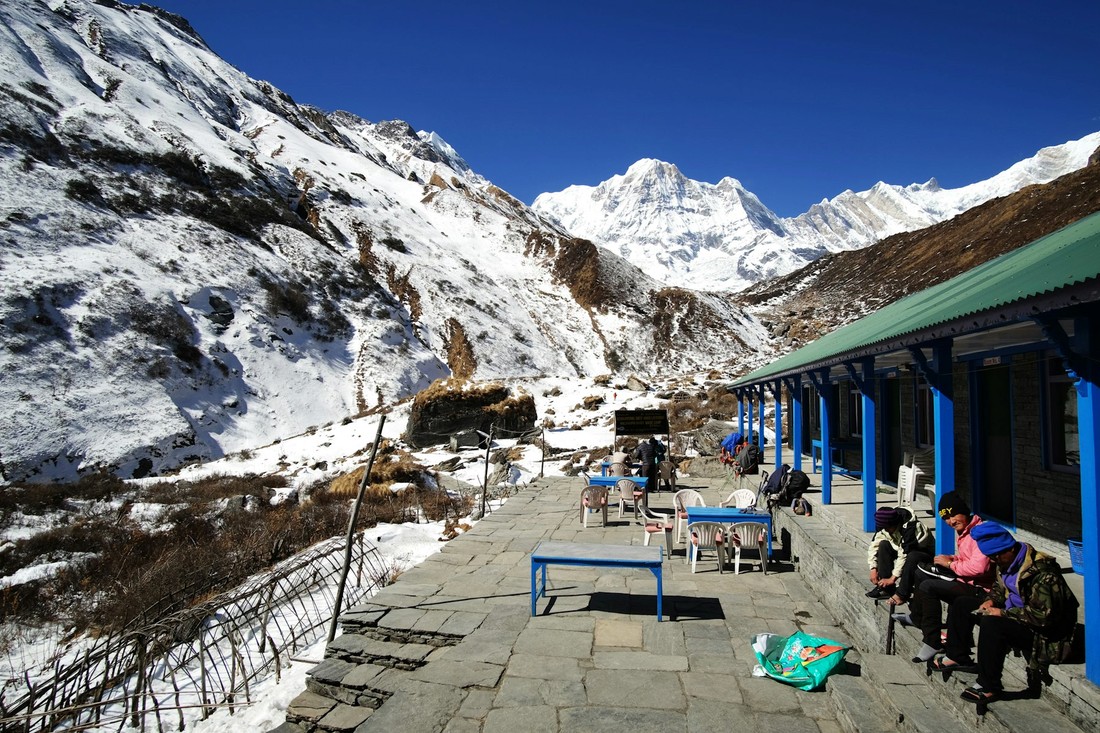 Teahouse terrace · rest with a view
 Machhapuchhre · first light on the fishtail
 Annapurna South · big snow above the ridge
Know what to expect. Know what to respect.
General guidance, not medical advice.
| What you notice | What it may mean | What to do |
|---|---|---|
| Mild headache, poor sleep, low appetite | Common early altitude effects | Rest, drink, eat and do not climb higher until it eases |
| Headache with nausea, dizziness or unusual tiredness | Possible acute mountain sickness | Do not go higher. Tell your guide. Descend if it worsens. |
| Confusion, loss of balance or coordination | Possible serious illness | Descend immediately and get medical help |
| Breathlessness at rest, wet cough, extreme weakness | Possible serious illness | Descend immediately and get medical help |
Talk to a doctor or travel clinic before you travel about altitude and any medication. Do not take medicines to mask symptoms and keep going.
At altitude, ego is expensive
The best-prepared people are often the best at turning around.
Setting turn-around rules with your guide before you leave, and following them, is the most useful altitude skill. Most altitude problems resolve with a rest day or a night lower down. The ones that turn serious usually involve someone who kept going.
- Drink steadily
Dry air and effort increase your fluid needs. Sip through the day.
- Eat before you are hungry
Appetite is a poor guide at height. Regular carbohydrate keeps energy and mood steady.
- Go slowly on purpose
A pace where you can hold a conversation is the right pace.
- Keep warm and rest well
Cold and poor sleep make altitude effects feel worse.
Alcohol and sleeping tablets can make sleep and breathing worse at height, so most guides advise leaving both until you are back lower down.
What the Thorong La day asks
The Circuit's pass is a different order of day.
The crossing of Thorong La at 5,416 m usually starts well before dawn from High Camp, and climbs for hours in the cold before a long descent to Muktinath. It is the hardest day on the loop and the one most affected by altitude. People who have acclimatised well, started slowly and kept warm do it comfortably. People who have rushed the days before often turn back or descend ill.
| Choice | Helps | Hurts |
|---|---|---|
| Itinerary | Rest days at Manang, short days into Thorong Phedi | A rushed schedule with big jumps in sleeping height |
| Pace | Slow and steady, conversation pace | Trying to keep up with a faster group |
| Fuel | Regular snacks and warm drinks | Skipping food because appetite is low |
| Decision | A clear turn-around rule agreed with your guide | Going on because you have come this far |
When descending is the treatment
The most effective response to altitude illness is also the simplest.
If symptoms worsen or serious signs appear, going down is the treatment. Even a few hundred metres can make a difference, and the sooner you do it, the better. Make it easy to say: agree with your guide and group in advance that anyone can call it, and that doing so is not a failure.
This guide is general information, not medical advice. Talk to a doctor or travel clinic before you travel about altitude and any medication.
A short altitude kit
Items that matter more at height.
- Warm layers
Temperatures drop fast after sunset and before dawn. A warm jacket, hat and gloves are essentials, not extras.
- A water system you can reach
Dry air and effort increase fluid needs. Drink little and often rather than catching up.
- Snacks you actually like
Appetite fades. Carry foods you have already eaten on long training days.
- Sun protection
UV is stronger at height, and snow reflects it. Sunglasses, hat and sunscreen matter.
Prepare for both challenges
Train the legs and respect the air.
The physical demands, the stairs and the descents, are things you can prepare for. Altitude is something you manage. Do both: train for the stairs and descents, and plan an itinerary with time to adapt.
Annapurna: FAQ
Is altitude sickness a risk at Annapurna Base Camp?
Yes. At about 4,130 m altitude illness can affect anyone, whatever their fitness. How you ascend and how you respond to symptoms decide it.
How high is it compared with Everest Base Camp?
About 4,130 m, against about 5,364 m. Lower, but still high enough that an unplanned ascent can cause problems.
Does fitness protect me from altitude sickness?
No. Fitness helps you move well and recover, but acclimatisation is a separate process that takes time.
What are the first signs of altitude illness?
Headache, poor sleep, low appetite and unusual tiredness. A headache with nausea or dizziness is a signal to stop climbing and tell your guide.
Should I take medication for altitude?
Speak to a doctor or travel clinic before you travel. Medication does not replace a sensible itinerary and honest reporting of symptoms.
When should I descend?
If symptoms are getting worse, or you have confusion, loss of coordination or breathlessness at rest, descend immediately and get medical help.
Fitness does not prevent altitude illness, but it gives you reserve for the walking. The free readiness check scores your seven capacities, and Trek Ready or 1:1 coaching builds the ones that need work.
- Annapurna Base Camp trek guideRoute map, day cards, versions and the seven demands.
- Nepal trekking hubEvery Himalayan trek Peaksted covers, with a route finder.
- Trek Ready, 8 weeksA structured plan that builds exactly these capacities.
- Eating and drinking at high altitudeHow to keep fuelling when appetite fades.
- How hard is Everest Base Camp?The classic Khumbu trek, rated the same way.
- How hard is Everest Three Passes?Three high crossings and the longest Khumbu circuit.
- Strength training for hikersThe two short sessions that protect your knees on descents.
- Stair training for trekkingThe most specific preparation for stone steps.
Sources and scope
Route and season information follows the Nepal Tourism Board page on the Annapurna Conservation Area and the Nepal tourism itinerary. Heights and stage times are approximate and vary with road access, weather and your itinerary. Confirm current permit, TIMS and guide requirements with an official source and a registered local operator. Altitude illness can affect anyone, whatever their fitness: tell your guide about symptoms and descend if they worsen. Training guidance is general and based on the demands described, not a personal prescription. Written by Nathan Gee, BSc Sports Science. If you have a health condition or injury, speak to a doctor or physiotherapist first.

