NEPAL · ANNAPURNA SANCTUARY

Annapurna Base Camp

Climb through Gurung villages, forest and the Modi Khola valley into the Annapurna Sanctuary. The Annapurna Base Camp trek asks for resilient legs, repeat walking days and respect for altitude.

Annapurna Sanctuary · Annapurna Conservation Area

Explore this trek
Annapurna Base Camp mountain landscape in Nepal

Plan the route

Annapurna Base Camp at a glance

Strenuous
Distance
Varies by trailhead
Time on trail
8–12 trekking days
Highest point
4,130 m · Annapurna Base Camp
Best season
Mar–May · Sep–Nov
Route type
Out-and-back · non-technical trek
Where you stay
Teahouses / lodges

Times, conditions and route variants can change. Check current local guidance before you set your itinerary.

OVERVIEW

Into the Annapurna Sanctuary

Annapurna Base Camp doesn’t start with a mountain. It starts with a staircase. From the trailhead near Pokhara the path climbs through Gurung villages and terraced hillsides, drops to a river and climbs again, and every flight of stone steps takes a little more from your legs. Beyond Chhomrong it follows the Modi Khola into forest, through Bamboo and Deurali, and then opens into the high Sanctuary: a ring of snow peaks, with Machhapuchhre and Annapurna South standing over Base Camp at about 4,130 m. The height is gentle next to Everest, but the work is steady, the steps are relentless and the descent is long. Allow roughly eight to twelve days, plus a buffer for travel and mountain weather.

Annapurna Base Camp doesn’t start with a mountain. It starts with a staircase. From the trailhead near Pokhara the path climbs through Gurung villages and terraced hillsides, drops to a river and climbs again, and every flight of stone steps takes a little more from your legs. Beyond Chhomrong it follows the Modi Khola into forest, through Bamboo and Deurali, and then opens into the high Sanctuary: a ring of snow peaks, with Machhapuchhre and Annapurna South standing over Base Camp at about 4,130 m. The height is gentle next to Everest, but the work is steady, the steps are relentless and the descent is long. Allow roughly eight to twelve days, plus a buffer for travel and mountain weather.

Annapurna Base Camp doesn’t start with a mountain. It starts with a staircase. From the trailhead near Pokhara the path climbs through Gurung villages and terraced hillsides, drops to a river and climbs again, and every flight of stone steps takes a little more from your legs. Beyond Chhomrong it follows the Modi Khola into forest, through Bamboo and Deurali, and then opens into the high Sanctuary: a ring of snow peaks, with Machhapuchhre and Annapurna South standing over Base Camp at about 4,130 m. The height is gentle next to Everest, but the work is steady, the steps are relentless and the descent is long. Allow roughly eight to twelve days, plus a buffer for travel and mountain weather.

NEPAL · ANNAPURNA SANCTUARY

What it demands of you

These are the same seven capacities used in the readiness check. Check your seven capacities →

The shape of the trek

Altitude profile of the Annapurna Base Camp trek from Ghandruk at 1,940 m to Annapurna Base Camp at 4,130 m
The Sanctuary route's overnight stops. Heights are approximate. Open full size
Annapurna Sanctuary route

The Annapurna Base Camp route, day by day

Follow one common Ghandruk approach to Annapurna Base Camp and back. This eight-day example shows where the climbs, altitude and long descent arrive. Times are estimates; road access, weather and your guide’s decisions may change the plan.

Chhomrong · 2,170 m

Villages and stone steps

From Ghandruk, the route reaches the Chhomrong steps before entering the Modi Khola valley. Expect repeated climbing and descending even before you gain much net height.

Selected map stopChhomrong · 2,170 m

Stone stairways and a major transition into the Sanctuary route.

The solid trail is based on OpenStreetMap’s Annapurna Base Camp hiking relation. The dashed Ghandruk link is illustrative because the mapped relation is incomplete there. Route variants and access change; this map is for planning, not navigation.

One way to walk it

Day 1 of 8
Day 01

Pokhara → Ghandruk

About 6 h, including road access
Ghandruk · ~1,940 m

Approach day. Confirm where the road ends before setting a walking target.

Day 02

Ghandruk → Chhomrong

About 6 h
Chhomrong · ~2,170 m

Rolling village trail and the first serious stair sections.

Day 03

Chhomrong → Bamboo

About 5 h
Bamboo · ~2,310 m

A sharp descent and climb. Net elevation hides how much work your legs do.

Day 04

Bamboo → Deurali

About 5 h
Deurali · ~3,230 m

Forest gives way to more open terrain. Monitor weather and how you feel.

Day 05

Deurali → Annapurna Base Camp via Machhapuchhre Base Camp

About 6 h
Annapurna Base Camp · ~4,130 m

A high-altitude day. Keep the pace conservative and report symptoms.

Day 06

Annapurna Base Camp → Bamboo

About 8 h
Bamboo · ~2,310 m

A long descent on accumulated fatigue: the key reason to train downhill.

Day 07

Bamboo → Jhinu Danda

About 6 h
Jhinu Danda · ~1,760 m

More steps and braking after the big return day.

Day 08

Jhinu Danda → Pokhara

About 7 h, including transfer
Pokhara

Trail exit and road travel vary with access and conditions.

Swipe the days on a phone or use the arrows. Times and overnight heights are approximate, not pace targets or total daily ascent.

Sample stages, times and overnight heights adapted from the Nepal tourism itinerary. Nepal Tourism Board describes the broader Sanctuary trek as roughly 8–12 trekking days.

The trail in photos

Eight days beneath the Annapurna peaks

  • Stone houses climbing a hillside on the lower trail
    Lower trail · stone villages on the hillside
  • A suspension bridge above a river valley and terraced hillsides
    Suspension bridges · terraces and river gorges
  • Worn stone steps rising through green forest
    Stone steps · where the legs get tested
  • A river running through a tree-lined valley
    River valley · forest and white water
  • Trekkers on an open mountain trail below a snow peak
    Above the trees · the valley opens up
  • A trekker on a snow-covered trail in the high valley
    Upper valley · snow on the trail
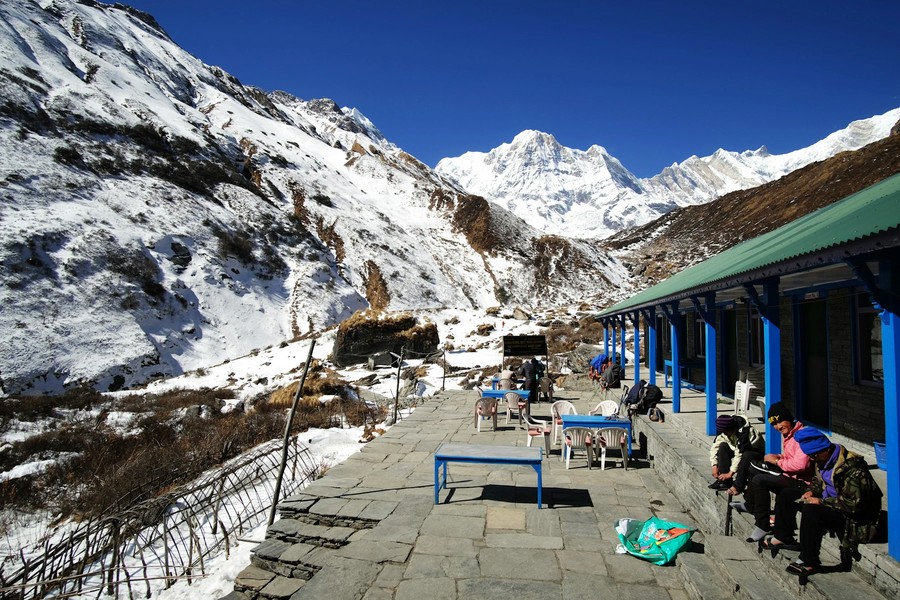
  • Trekkers resting outside a teahouse beneath snow peaks
    Teahouse terrace · rest with a view
  • The fishtail peak of Machhapuchhre glowing pink at dawn
    Machhapuchhre · first light on the fishtail
  • A hiker silhouetted below the snowfields of Annapurna South
    Annapurna South · big snow above the ridge
  • Trekkers posing at the Annapurna Base Camp sign
    Annapurna Base Camp · 4,130 m

TERRAIN PROGRESSION

On the Trail

Drag to explore

Stone houses climbing a hillside on the lower trail
Worn stone steps rising through green forest
A river running through a tree-lined valley
Trekkers on an open mountain trail below a snow peak
Trekkers at the Annapurna Base Camp sign

Read these before you decide

Short, free guides on this trek, from what makes it hard to how to train for it.

Free, written by Nathan Gee.

Where do you stand for Annapurna Base Camp?

Your longest recent hike?
Two long days in a row?
Long descents on tired legs?

Three quick taps show where to start. It is not your full score.

Which Peaksted plan fits your Annapurna Base Camp preparation?

Annapurna Base Camp rewards stair-climbing capacity, downhill control and the ability to repeat days. Pick the support that fits your timeline.

How long until you leave?
How much support do you want?

Answer both questions to see the plan that fits your Annapurna Base Camp preparation.

Who is coaching you, and what clients say

  • Nathan GeeBSc Sports Science · 8 years coaching strength and conditioning · mountain guide
  • Lauren JonesStudying towards NASM Sports Nutrition Qualification · co-founder and content lead
  • ★★★★★
    “Before Trek Ready I was doing plenty of cardio, but my training had no real structure. The programme gave me a clear plan and I felt noticeably stronger and more capable on longer hikes.”
    Savannah RoseTrek Ready →
  • ★★★★★
    “Having the training built around my actual trek made a massive difference. I knew exactly what I was training for each week instead of just trying to get generally fitter.”
    Tom Williams1:1 Mountain Performance Coaching →
1 / 2

Frequently asked questions

How hard is the Annapurna Base Camp trek?

It is non-technical, but repeated stone steps, long descents and several walking days make it a substantial trek, with real altitude at 4,130 m. The gap between what the trek demands and what you can repeat day after day decides how it feels.

Is Annapurna Base Camp the same as the Annapurna Circuit?

No. Annapurna Base Camp, also called the Annapurna Sanctuary trek, is an out-and-back walk finishing at about 4,130 m. The Annapurna Circuit, or Loop, is a longer trek over the 5,416 m Thorong La pass, usually 12 to 21 days.

How fit do I need to be for Annapurna Base Camp?

Well prepared, not elite. Aerobic base, time on your feet, uphill capacity, downhill durability, strength, pack capacity and multi-day durability matter more than a single running time.

How long should I train for Annapurna Base Camp?

Eight to ten weeks is a sensible window if you already walk regularly, and longer if you are starting from low activity. Trek Ready is built around 8 weeks.

Can a beginner do Annapurna Base Camp?

Yes, with preparation. Allow ten weeks or more, build gradually and talk to a doctor before you start.

What should I train most for Annapurna Base Camp?

Stairs and sustained climbing, controlled descents, a loaded daypack and back-to-back long days. Strength training and easy aerobic work support all four.

Peaksted does not book treks. Your operator handles permits, lodges and logistics, so confirm current requirements with them and with official sources. What we cover is arriving prepared. Nepal Tourism Board: Annapurna Conservation Area.

Written by Nathan Gee · Reviewed 6 Oct 2026 · General education, not medical advice. If you have a health condition, talk to a doctor before you train or book.

Trek-specific preparation for demanding objectives.

Trail Notes

Practical trek training, pacing and field notes for your next objective.

© 2026 Peaksted. All rights reserved.

PREPARE WELL. TREK FAR. RESPECT ALWAYS.

Trek-specific preparation for demanding objectives.

Trail Notes

Practical trek training, pacing and field notes for your next objective.

© 2026 Peaksted. All rights reserved.

PREPARE WELL. TREK FAR. RESPECT ALWAYS.

Trek-specific preparation for demanding objectives.

Trail Notes

Practical trek training, pacing and field notes for your next objective.

© 2026 Peaksted. All rights reserved.

PREPARE WELL. TREK FAR. RESPECT ALWAYS.

CHECK YOUR READINESSFree · about 3 minutes