Times, conditions and route variants can change. Check current local guidance before you set your itinerary.
OVERVIEW
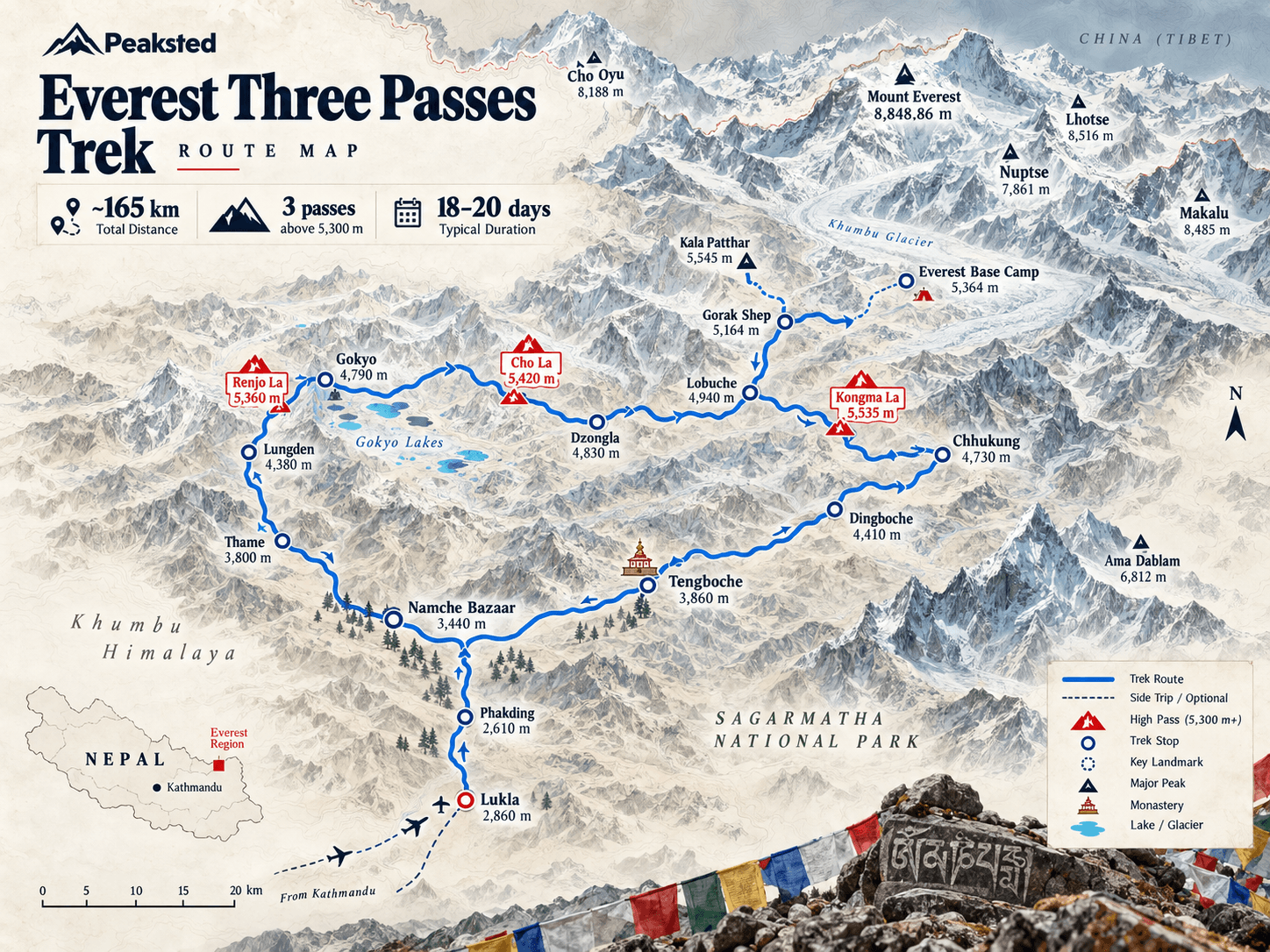
The Three Passes circuit uses the familiar Lukla–Namche approach, then moves beyond the standard Everest Base Camp itinerary. One common anticlockwise route acclimatises around Namche and Dingboche, crosses Kongma La towards Lobuche, visits the Everest Base Camp area, crosses Cho La to Gokyo, then returns over Renjo La and down via Thame. The order, side trips and number of days vary by operator and conditions. Treat this as a route overview, not a fixed itinerary: agree acclimatisation days, weather buffers and alternatives with your local guide.
The Three Passes circuit uses the familiar Lukla–Namche approach, then moves beyond the standard Everest Base Camp itinerary. One common anticlockwise route acclimatises around Namche and Dingboche, crosses Kongma La towards Lobuche, visits the Everest Base Camp area, crosses Cho La to Gokyo, then returns over Renjo La and down via Thame. The order, side trips and number of days vary by operator and conditions. Treat this as a route overview, not a fixed itinerary: agree acclimatisation days, weather buffers and alternatives with your local guide.
The Three Passes circuit uses the familiar Lukla–Namche approach, then moves beyond the standard Everest Base Camp itinerary. One common anticlockwise route acclimatises around Namche and Dingboche, crosses Kongma La towards Lobuche, visits the Everest Base Camp area, crosses Cho La to Gokyo, then returns over Renjo La and down via Thame. The order, side trips and number of days vary by operator and conditions. Treat this as a route overview, not a fixed itinerary: agree acclimatisation days, weather buffers and alternatives with your local guide.
NEPAL · HIGH KHUMBU
Free readiness check
How ready are you for Everest Three Passes?
Twelve questions, about three minutes. See your score against what Everest Three Passes asks of you, and the one gap worth fixing first.
The illustrated map above shows one common anticlockwise circuit. Its ~165 km and 18–20 days are one example; side trips, stops and conditions change the total. Use it to understand the route, never to navigate.
The line shows an illustrative sequence of route high points and valley stops. A pass height is not your sleeping height, and fitness does not prevent altitude illness.
APPROXIMATE ELEVATIONKongma La: ~5,535 m
THE CROSSING / PASS 01 / 03
Kongma La: what changes underfoot
The first high crossing links the Dingboche side to Lobuche over rough, exposed ground.
Prepare for it
Rehearse sustained uphill effort and a controlled descent while carrying your actual daypack.
Approximate heights; route order and overnight stops depend on the itinerary. The time estimates are examples, not crossing promises. If altitude symptoms appear, follow current medical and local guidance. Nepal Tourism Board mountain safety →
TERRAIN PROGRESSION
On the Trail
Drag to explore
01 / READ FIRST
Read these before you decide
Start with the Three Passes training framework, then use these focused guides for altitude awareness, pacing, descents and pack work. Your local guide handles route and conditions.
Three quick taps show where to start. It is not your full score.
03 / YOUR PLAN
Which Peaksted plan fits your Three Passes preparation?
Three Passes asks for repeated long climbs, rough descents and good recovery. Choose support around your date and current capacity; keep altitude decisions with your guide and medical adviser.
Answer both questions to see the plan that fits your Three Passes preparation.
04 / PROOF
Who is coaching you, and what clients say
Nathan GeeBSc Sports Science · 8 years coaching strength and conditioning · mountain guide
Lauren JonesStudying towards NASM Sports Nutrition Qualification · co-founder and content lead
★★★★★
“Before Trek Ready I was doing plenty of cardio, but my training had no real structure. The programme gave me a clear plan and I felt noticeably stronger and more capable on longer hikes.”
“Having the training built around my actual trek made a massive difference. I knew exactly what I was training for each week instead of just trying to get generally fitter.”
Difficult. It combines multiple high-altitude days with three long pass crossings, rough footing and repeated descents. Conditions can change the demand considerably.
Which three passes does the route cross?+
Kongma La, Cho La and Renjo La. A common circuit approaches via Namche and Dingboche, then moves toward Gokyo and returns via Thame; exact order and side trips vary.
How long should I allow?+
Published itineraries vary. About 15–20 days is a useful planning range, with acclimatisation and weather flexibility rather than a fixed minimum.
Do I have to visit Everest Base Camp?+
No. Many itineraries include it as a side trip, but the three pass crossings define the circuit. Agree your route with your operator.
Is it technical climbing?+
Usually described as trekking, but pass conditions may include loose rock, snow and ice. A clear footpath is not guaranteed. Follow current local guidance and turn back when conditions require it.
Will fitness prevent altitude sickness?+
No. Fit trekkers can develop altitude illness. A suitable ascent profile, symptom awareness and prompt decisions to stop or descend matter; seek medical advice before travel.
Peaksted trains you for the physical demands; your operator handles route, guide, permits and lodges. Confirm current conditions and requirements before travel. Nepal Tourism Board: guide and TIMS information.
Written by Nathan Gee · Reviewed 6 Oct 2026 · General education, not medical advice. If you have a health condition, talk to a doctor before you train or book.

 Khumbu trail · a chorten above the Everest range
 Ama Dablam · the eastern Khumbu skyline
 Rough ground · porters on a high moraine
 Gokyo · turquoise lakes in a high valley
 Gokyo Ri · the Ngozumpa glacier below
 High lakes · a yak at the water's edge
 Pass terrain · loose rock and early snow
 Glacier moraine · boulders, no easy line
 Prayer flags · Everest and Nuptse
 Nuptse · big walls above the trail


 Start here


