Times, conditions and route variants can change. Check current local guidance before you set your itinerary.
OVERVIEW
You're looking at around 60 km of hiking, with the long climb toward Luxmore, an exposed alpine section, plenty of descending and several days of moving on tired legs. It's a well-formed Great Walk, but that doesn't mean it's effortless. The biggest difference comes from arriving with enough aerobic fitness, downhill durability and multi-day capacity that you can actually enjoy the ridge instead of just surviving it.
You're looking at around 60 km of hiking, with the long climb toward Luxmore, an exposed alpine section, plenty of descending and several days of moving on tired legs. It's a well-formed Great Walk, but that doesn't mean it's effortless. The biggest difference comes from arriving with enough aerobic fitness, downhill durability and multi-day capacity that you can actually enjoy the ridge instead of just surviving it.
You're looking at around 60 km of hiking, with the long climb toward Luxmore, an exposed alpine section, plenty of descending and several days of moving on tired legs. It's a well-formed Great Walk, but that doesn't mean it's effortless. The biggest difference comes from arriving with enough aerobic fitness, downhill durability and multi-day capacity that you can actually enjoy the ridge instead of just surviving it.
GREAT WALK · AOTEAROA
Free readiness check
How ready are you for the Kepler Track?
Twelve questions, about three minutes. See your score against what the Kepler Track asks of you, and the one gap worth fixing first.
The big climb comes early; the ridge is the high ground. Heights are approximate. Open full size
01 / THE LOOP
Sixty kilometres, four days, one big idea
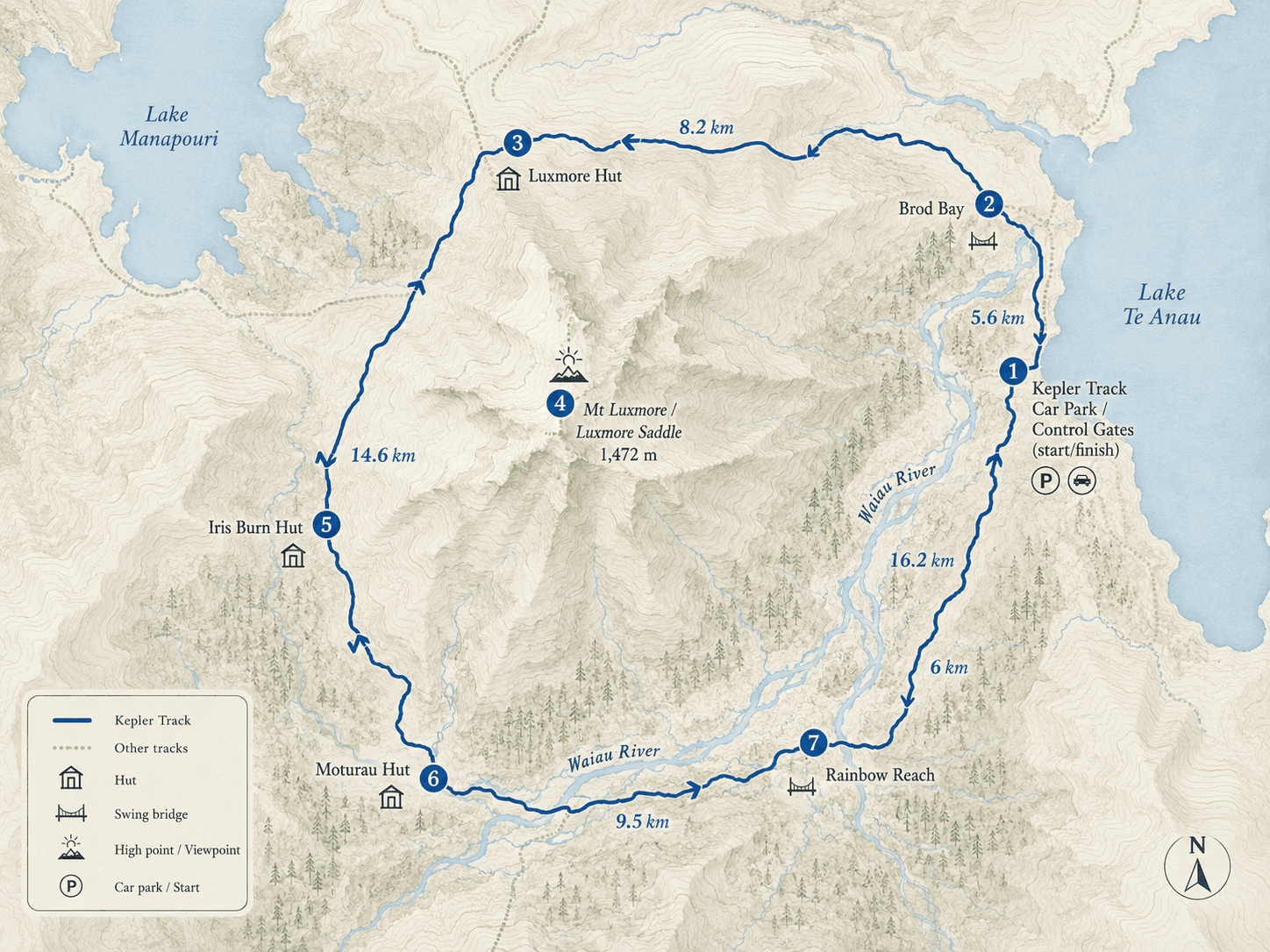
The Kepler is a loop. You leave from the Control Gates near Te Anau, climb to the alpine tops, cross the ridge, drop into the Iris Burn valley and come home along the shore of Lake Manapouri and the Waiau River. It is a well-formed Great Walk, and that is exactly why people underestimate it.
02 / DAY BY DAY
What each day asks of you
Distances and times follow the Department of Conservation’s published figures. Allow more in poor weather.
1
Control Gates to Luxmore Hut
The climb
14 km · about 5–6 h
Lakeshore, then beech forest, then a steady switchbacked climb to the bushline and out onto the Luxmore tops. Most of the trip's climbing is here, and it arrives early.
What it asks Uphill capacity and pacing. Start easy: you are climbing before you are warm.
2
Luxmore Hut to Iris Burn Hut
The ridge
14.6 km · about 5–6 h
Open alpine tops with views both ways, no shelter, and the weather in charge. Then a long descent through forest into the Iris Burn valley and past the falls.
What it asks Time on feet, downhill durability and layers. This is the day the trip is remembered for.
3
Iris Burn Hut to Moturau Hut
The long middle
16.2 km · about 5–6 h
Forest, gentle gradients and then the shore of Lake Manapouri. The longest day by distance, and the kindest underfoot.
What it asks Multi-day durability. You are on day three, and the day is long rather than hard.
4
Moturau Hut to Control Gates
The flat finish
14.9 km · about 4–5 h
A riverside and wetland path along the Waiau. Easy ground, but it is the fourth day and the finish line keeps moving.
What it asks Steady pacing and food. Tired legs on flat ground still need fuel.
03 / WHAT CATCHES PEOPLE OUT
Three things people underestimate
The ridge has no shelter
The tops between Luxmore and Iris Burn are open. Weather can close in fast, and there is no quick way off, so layers and a plan for turning the day around matter.
The climb comes first
You gain the most height before you are properly warmed up. Go out slowly: an aerobic pace on day one pays back across the next three.
It compounds
Three or four days of 4 to 7 hours is not hard on any one day. It is hard because the fatigue stacks, and the final day is long and flat.
04 / TRAINING
Training that fits the Kepler
1
Build steady climbing
A conversational aerobic base first, then hills, stairs or incline walking so day one feels repeatable rather than heroic.
The Kepler is a Great Walk, walked between huts in the November to April season. Huts and campsites sell out months ahead for summer, and once you commit to the Luxmore to Iris Burn section there is no easy bail-out, so book first and plan your fitness around the dates you get.
Local tip. Book Great Walk huts well ahead for summer. Check conditions and track status with DOC before you go, and read the MetService mountain forecast the morning you start.
Three quick taps show where to start. It is not your full score.
03 / YOUR PLAN
Which Peaksted plan fits your Kepler preparation?
The Kepler rewards an aerobic base, strong descents and the habit of linked days. If you want structure behind that, choose support around your date and starting point.
Answer both questions to see the plan that fits your Kepler preparation.
04 / PROOF
Who is coaching you, and what clients say
Nathan GeeBSc Sports Science · 8 years coaching strength and conditioning · mountain guide
Lauren JonesStudying towards NASM Sports Nutrition Qualification · co-founder and content lead
★★★★★
“Before Trek Ready I was doing plenty of cardio, but my training had no real structure. The programme gave me a clear plan and I felt noticeably stronger and more capable on longer hikes.”
“Having the training built around my actual trek made a massive difference. I knew exactly what I was training for each week instead of just trying to get generally fitter.”
Moderate, but not easy. It is a well-formed Great Walk with a long climb on day one, an exposed ridge on day two and several days of walking on tired legs.
How long does it take?+
Usually three to four days and about 60 km, walked hut to hut. Allow longer in poor weather.
What is the hardest part?+
Most people say the first-day climb and the ridge day: the climb arrives before you are warm, and the ridge is open with no shelter.
When should I go?+
The Great Walks season, roughly November to April. Huts and campsites sell out months ahead for summer, so book early.
How fit do I need to be?+
Comfortable with 4 to 7 hours of walking on varied terrain, able to climb steadily and descend well, and able to do it again the next morning.
How long should I train?+
Eight to twelve weeks is a sensible window for most reasonably fit walkers: an aerobic base first, then linked long days.
Is the ridge dangerous?+
It is exposed. Weather can close in fast and there is no quick way off, so check conditions with DOC, carry layers and agree turn-around rules in advance.
Peaksted trains you for the physical demands; DOC and your own planning cover bookings, conditions and gear. Confirm current track status before you go. DOC: Kepler Track.
Written by Nathan Gee · Reviewed 6 Oct 2026 · General education, not medical advice. If you have a health condition, talk to a doctor before you train or book.
Guide series
Prepare for the New Zealand Great Walks, one question at a time
Three short guides that build on each other. Each answers one question and links to the others instead of repeating them. Read them in order, or jump to what you need.

 Above the bushline · the tops open up
 The exposed alpine tops
 Beech forest · moss and fern
 The long descent off the tops
 Back to the valley at dusk


 Start here


 1Part 1 · How hard · 8 minHow Hard Are the Great Walks?Which is easiest, which is hardest, and which should I pick?Read guide →
 2Part 2 · How fit · 6 minHow Fit Do You Need to Be?What do I train, and where do I start?Read guide →
 3Part 3 · How to train · 10 minHow to Train for the Great WalksWhat do I actually do each week?Read guide →

